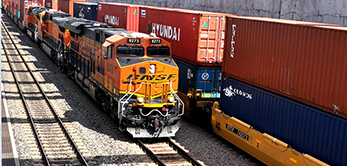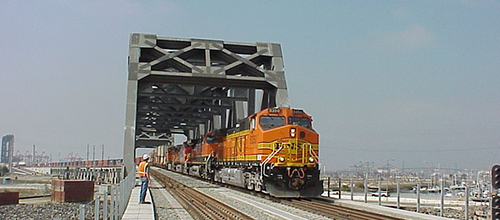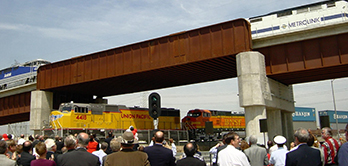
The cities and ports of Long Beach and Los Angeles and surrounding communities have long sought ways to improve transportation systems to accommodate steadily increasing cargo volumes while minimizing the impact on residents and businesses. One result of their efforts is the Alameda Corridor, a 20-mile-long rail expressway linking the ports to the transcontinental rail yards near downtown Los Angeles.
The $2.4 billion Alameda Corridor is a testament to the vision, cooperation and perseverance of many disparate parties. Here are some key dates in the evolution of the Alameda Corridor from a low-budget planning study to on-time on-budget delivery of one of the nation’s largest public works projects.
1970’s
Facing increases in cargo crossing their docks, ports of Long
Beach and Los Angeles begin to study comprehensive rail and
highway improvements to improve the efficiency of cargo movements.
October 1981
Southern California Association of Governments (SCAG) forms Ports
Advisory Committee (PAC) in response to growing concerns about the
ability of ground transportation systems to accommodate increasing
levels of cargo flowing through the ports. Members include local
elected officials and representatives of the ports, the U.S. Navy,
Army Corps of Engineers, railroads, trucking industry and the Los
Angeles County Transportation Commission (predecessor to the Metropolitan
Transportation Authority).
March 1982
PAC recommends comprehensive list of highway improvements, including
the widening of Alameda Street from State Route 91 south to the
ports.
December 1984
SCAG Executive Committee adopts plan recommended by PAC to consolidate
port-related rail traffic from four branch lines into the former
Southern Pacific Railroad’s San Pedro Branch, a 20-mile line
running parallel to Alameda Street between the ports and the transcontinental
rail yards near downtown Los Angeles. This would become the general
route of the Alameda Corridor.
February 1985
SCAG forms Alameda Corridor Task Force to pursue consolidated rail
cargo expressway. Task force begins to develop consensus on institutional
arrangements, phasing and funding. Membership similar to PAC, with
addition of California Public Utilities Commission and each of the
eight cities along the route.
November 1988
Ports of Long Beach and Los Angeles publish Consolidated Rail Corridor
Strategic Plan recommending rail cargo expressway.
August 1989
Joint powers authority formed by cities and ports of Long Beach
and Los Angeles to design and construct a rail cargo expressway.
The agency was originally called the Consolidated Transportation
Corridor Joint Powers Authority. The Governing Board originally
included 16 members, with representatives of all the cities along
the route in addition to Long Beach and Los Angeles, the two ports
and other agencies.
April 1990
Governing Board selects first General Manager, opens temporary agency
office at Huntington Park, Calif., City Hall, selects joint venture
of Daniel Mann Johnson Mendenhall (DMJM) and Moffatt & Nichol
Engineers to conduct feasibility study, prepare environmental documents.
March 1991
Governing Board recommends agency name change to Alameda Corridor
Transportation Authority (ACTA) to better reflect the selected route
along Alameda Street. City and port approvals follow.
January 1993
ACTA Governing Board approves “Plan for the Alameda Corridor”
and certifies Environmental Impact Report (EIR) required by the
state for the project to proceed.
December 1994
Ports complete purchase of necessary rights-of-way from railroads
for $394 million.
October 1995
Governing Board selects joint venture of civil engineering firms,
known as Alameda Corridor Engineering Team (ACET), to serve as lead
program manager. ACET includes the firms of Daniel Mann Johnson
Mendenhall (DMJM), Moffatt & Nichol Engineers, Jenkins-Gales
& Martinez, Inc., and TELACU.
November 1995
National Highway System Designation Act becomes law and names Alameda
Corridor a “high-priority corridor,” making the project
eligible for a federal loan. During debate, Senators refer to Alameda
Corridor as a “project of national significance.”
January 1996
ACTA establishes permanent offices in Carson, Calif., and expands
professional staff.
February 1996
Governing Board certifies federal Environmental Impact Statement
(EIS), and federal transportation officials approve permit to construct
project.
September 1996
Congress approves Transportation Appropriations Bill that includes
$58.68 million needed to back a $400 million Department of Transportation
loan for the Alameda Corridor.
January 1997
Then-President Clinton hosts White House signing ceremony for $400
million loan, attended by ACTA officials, the Mayors of Long Beach
and Los Angeles, and port officials.
January 1997
Composition of ACTA Governing Board changed to seven members: two
representatives from each of the two ports; a representative of
the Long Beach City Council; a representative of the Los Angeles
City Council, and a representative of the Los Angeles County Metropolitan
Transportation Authority.
April 1997
Construction commences with work on three-track rail bridge over
Los Angeles River, replacing a single-track bridge first built in
1905.
June 1997
Governing Board requests authorization to utilize design-build approach
on the Mid-Corridor Trench, the project’s biggest contract.
Subsequent Los Angeles City Council authorization saves an estimated
14-18 months from traditional project delivery approach by allowing
simultaneous design work and construction of certain elements.
October 1998
Governing Board approves Use and Operating Agreement with Union
Pacific Railroad and Burlington Northern Santa Fe Railway. The agreement
calls for railroads to pay fees for use of the Alameda Corridor,
creating a revenue stream needed to pay off the federal loan and
bonds.
October 1998
Governing Board awards contract for Mid-Corridor Trench, the project’s
single largest contract and centerpiece, to team led by Tutor-Saliba
Corporation.
November 1998
ACTA dedicates first completed project of the Alameda Corridor,
the Los Angeles River Bridge.
December 1998
Construction on Mid-Corridor Trench commences with groundbreaking
ceremony attended by federal, state and local elected officials.
February 1999
Private investors purchase last of $1.16 billion in ACTA revenue
bonds, completing the project’s funding package.
November 2000
Project reaches peak construction period, with up to 1,500 people
working up and down the route on any given day.
July 2001
Governing Board authorizes ACTA to manage design and construction
of additional project, the Pacific Coast Highway Grade Separation.
Area legislators had urged ACTA’s involvement to expedite
California Department of Transportation project.
August 2001
ACTA dedicates Redondo Junction project, a series of five separate
bridge structures stretching the length of eight football fields
and separating cargo rail lines from street traffic as well as commuter
rail lines.
September 2001
Excavation of Mid-Corridor Trench completed.
December 2001
Testing of electronic revenue
collection system begins.
March 2002
Railroad track installation completed in Mid-Corridor Trench.
April 2002
Revenue operations begin following grand opening ceremony attended
by federal, state and local elected officials.
April 2005
Third Anniversary marks $173M in
colleted revenues, 45,000 trains over 5 million containers (9,000
TEU's) carried, and 1169 tons and 49 tons reduction of NOx and PM
pollutants respectively.